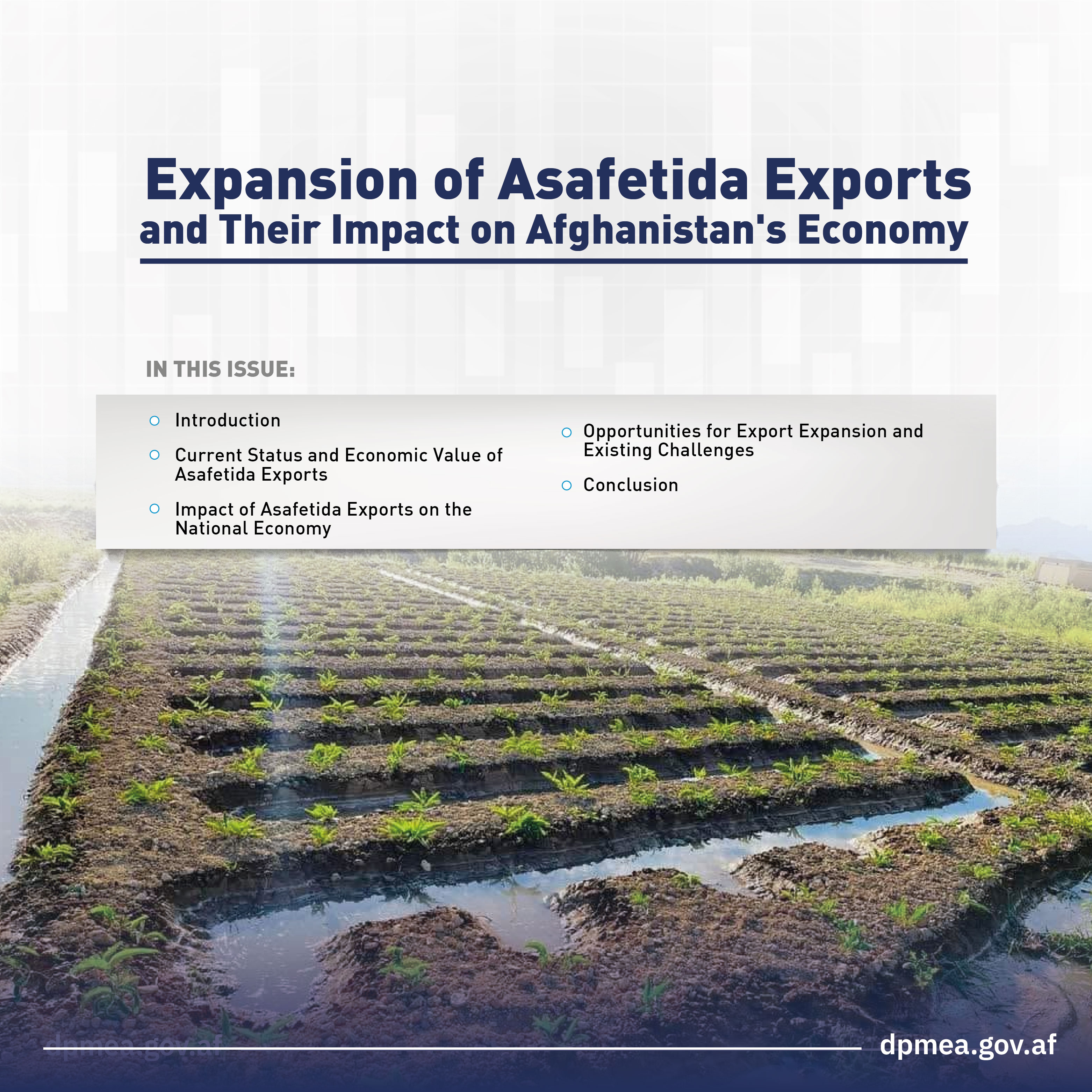
Expansion of Asafetida Exports and Their Impact on Afghanistan's Economy
By: Zahid Khan
Introduction
Afghanistan possesses significant potential for the cultivation of a wide range of medicinal plants due to its favorable geographical location, diverse climate, and abundant natural resources. Among these, asafetida has emerged as one of the country's most valuable medicinal and export-oriented crops. In recent years, it has become an increasingly important component of Afghanistan's agricultural economy.
The crop's high international market value, relatively low water requirements, and strong demand in foreign markets have made it an attractive option for Afghan farmers. Following the ban on poppy cultivation by the Islamic Emirate of Afghanistan, asafetida cultivation has expanded considerably across many provinces, making a notable contribution to the country's export growth. With greater investment in production, processing, and value addition, this sector has the potential to make an even greater contribution to Afghanistan's economic development.
Current Status and Economic Value of Asafetida Exports
Asafetida is among Afghanistan's most valuable export commodities, enjoying strong demand in international markets. According to the Ministry of Agriculture, Irrigation and Livestock, both the cultivation area and production volume of the crop have increased steadily in recent years. Thousands of hectares of land have been brought under cultivation, producing thousands of metric tons of asafetida annually.
Afghanistan's principal export destinations for asafetida include India, Iran, the United Arab Emirates, and the United States, with India representing the largest market. Owing to its high quality, Afghan asafetida commands premium prices internationally, generating substantially higher returns for farmers than many conventional agricultural products.
The crop is cultivated across numerous provinces, including Samangan, Balkh, Takhar, Baghlan, Faryab, Badakhshan, Jawzjan, Ghazni, Nangarhar, and Helmand. Agricultural experts regard asafetida as a sustainable and economically viable alternative to poppy cultivation.
Impact of Asafetida Exports on the National Economy
The expansion of asafetida exports has several positive effects on Afghanistan's economy.
First, increased exports contribute directly to higher export earnings and strengthen the country's foreign exchange reserves. As export volumes rise, the inflow of foreign currency also increases, supporting macroeconomic stability and improving the balance of trade.
Second, asafetida cultivation serves as an important source of income for rural communities. The cultivation, maintenance, resin extraction, transportation, processing, and marketing of the crop create employment opportunities for thousands of Afghans. Experiences from Helmand, Nangarhar, and several northern provinces demonstrate that a single jerib of asafetida cultivation can generate several times more income than many traditional crops, significantly improving farmers' livelihoods.
Third, the growth of asafetida exports contributes to the diversification of Afghanistan's agricultural export portfolio. For many years, the country has relied on a limited range of export commodities. Expanding the production of high-value medicinal plants such as asafetida can diversify exports, reduce dependence on traditional products, and better meet evolving international market demand.
Furthermore, establishing domestic processing and packaging facilities would enable Afghanistan to export value-added products rather than raw materials. This would substantially increase export revenues while generating additional employment opportunities and strengthening the country's industrial base.
Opportunities for Export Expansion and Existing Challenges
Although Afghanistan enjoys favorable climatic conditions and abundant natural resources for asafetida production, several challenges continue to hinder the sector's full development. These include the shortage of improved seeds, limited technical knowledge among farmers, and the absence of modern processing and packaging facilities. Addressing these constraints is essential for enhancing productivity and improving international competitiveness.
Recognizing both the importance of asafetida exports and the challenges facing the sector, the Office of the Deputy PM for Economic Affairs has initiated practical measures to support its development. During a regular meeting of the Technical Committee of the Economic Commission, held at the Marmarin Palace on June 22, 2026, members discussed the expansion of asafetida exports and measures to resolve existing challenges in the sector.
In accordance with the committee's decision, a joint committee led by the Ministry of Industry and Commerce was tasked with conducting a comprehensive assessment and submitting a report, together with specific recommendations, to the Economic Commission. This decision reflects the fact that expanding asafetida exports has become one of the economic priorities of the Islamic Emirate of Afghanistan, with ongoing efforts focused on strengthening policy coordination and supporting the long-term development of the sector.
At the same time, considerable opportunities exist for future growth. Rising global demand, Afghanistan's favorable climate, relatively low production costs, and the growing interest of farmers all provide strong prospects for significantly increasing asafetida exports in the coming years.
To fully realize this potential, greater attention should be given to the production of improved seed varieties, specialized farmer training, establishment of modern processing and packaging facilities, compliance with international quality standards, and the identification of new export markets. These measures would further enhance the international reputation and competitiveness of this valuable Afghan product.
Conclusion
Asafetida is one of Afghanistan's most promising agricultural and medicinal products, offering substantial potential to expand exports and strengthen the rural economy. Its cultivation has become a sustainable and profitable source of income for thousands of Afghan farmers.
However, maximizing the sector's contribution to national economic growth requires investment not only in production but also in processing, packaging, quality assurance, and international marketing. By developing these areas, Afghanistan can strengthen its position in the global asafetida market, increase the value of its exports, generate greater foreign exchange earnings, and accelerate sustainable economic growth.