The Second Jabal al-Siraj Cement Production Plant
Qais Ahmad
Introduction
Over the past four years, the Islamic Emirate of Afghanistan has given special attention to the implementation of infrastructure projects across the country. To promote economic growth, create employment opportunities, attract investment, and achieve self-sufficiency, the Islamic Emirate has prioritized infrastructure development. Among these initiatives are the construction of new cement production plants and the expansion of the production capacity of several existing factories.
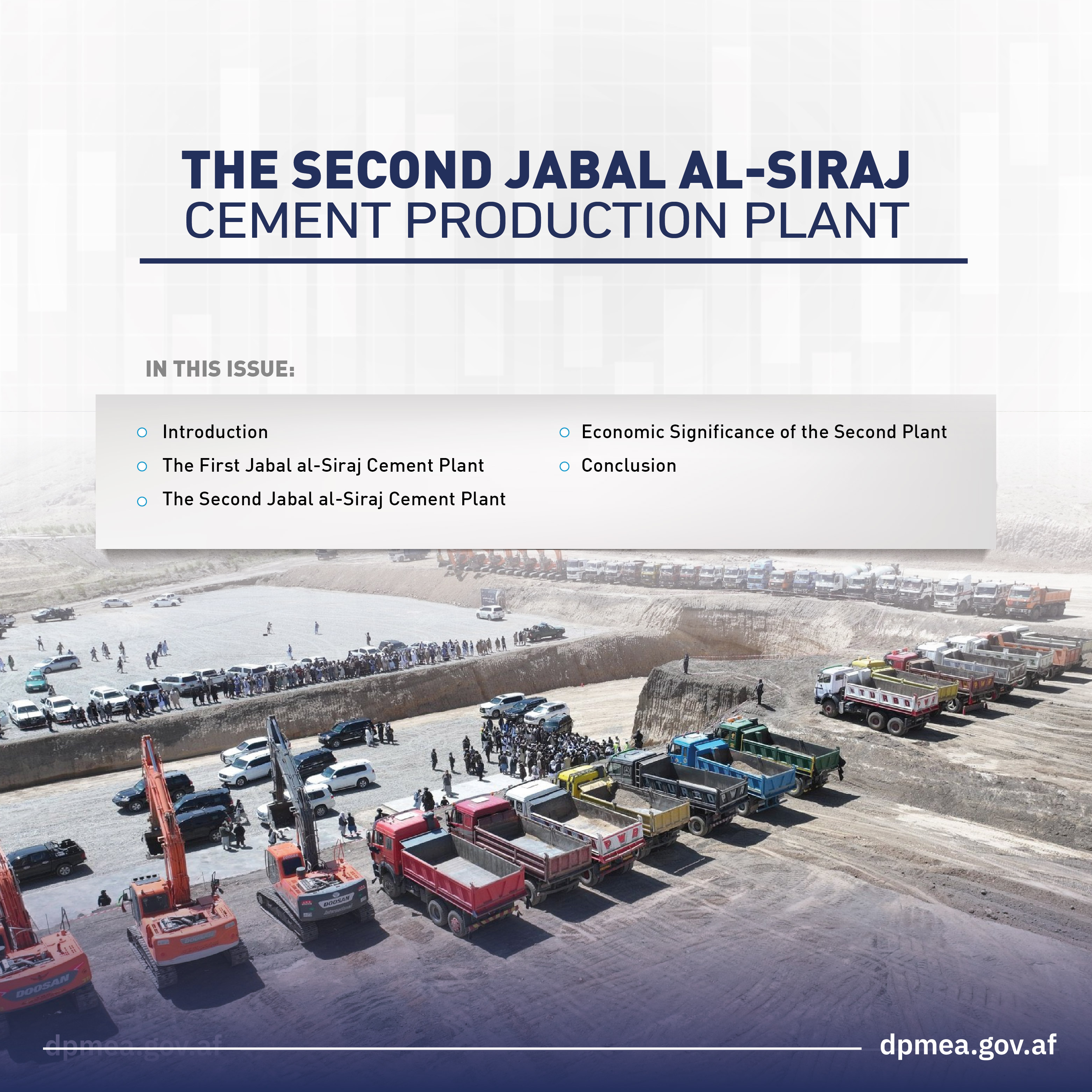
One such initiative is the construction of a second cement plant alongside the existing Jabal al-Siraj Cement Plant. Construction of the second Jabal al-Siraj Cement Plant officially commenced on July 9, 2026, in Parwan Province, in the presence of the Deputy PM for Economic Affairs, Mullah Abdul Ghani Baradar Akhund, along with several other senior officials.
This article briefly discusses the economic significance of this factory.
The First Jabal al-Siraj Cement Plant
The first Jabal al-Siraj Cement Plant was established in 1958 as a joint-stock company with an investment of 40 million Afghanis in Jabal al-Siraj District of Parwan Province. The plant had a production capacity of 100 tons of cement per day, meeting all applicable production standards. Its cement was used in infrastructure projects throughout the country, including dams, roads, buildings, bridges, culverts, and other construction works.
The plant played a significant role in meeting domestic cement demand and also exported cement to several neighboring countries. Most of its machinery and technology were imported from Czechoslovakia, Germany, and Russia. However, the plant sustained extensive damage during the years of foreign occupation and armed conflict in Afghanistan.
Following the return of the Islamic Emirate to power, special attention was given to rehabilitating the plant and increasing its production capacity. Through the efforts of the National Development Corporation, the factory resumed operations and currently produces dozens of tons of cement daily while providing employment to many Afghan citizens.
The Second Jabal al-Siraj Cement Plant
One of the most important ways to transition from an import-based economy to a production-based economy is to activate the industrial sector. A key component of industry is the processing of raw materials into finished products for productive use. Afghanistan possesses abundant raw materials required for cement production; however, existing production facilities have not yet been able to meet domestic demand. Therefore, the Islamic Emirate decided to construct the second Jabal al-Siraj Cement Production Plant.
The foundation stone of the factory was laid a few days ago by senior officials of the Islamic Emirate, and construction has officially commenced. The plant is being built by the National Development Corporation on dozens of jeribs of land, with a planned production capacity of 5,000 tons of cement per day.
Most of the factory's technical machinery and equipment are being manufactured by the National Development Corporation, and the project is expected to create employment opportunities for thousands of people simultaneously. Once operational, the factory will significantly contribute to meeting the country's existing demand for cement.
Economic Significance of the Second Plant
Thanks to the Islamic Emirate's economy-oriented policies and its special focus on infrastructure projects, construction activities throughout the country continue to increase. The Qosh Tepa Canal, the Salang Highway, the Kabul-Jalalabad second road, the first carriageway of the Kabul–Kandahar Highway, the second carriageway of the Kabul–Ghazni Highway, the Laghman Shahi Canal, the Qadis-e-Khordak and Palatuni Dams, the construction of industrial factories across all provinces, and the construction of residential apartments and housing in major cities are examples of these development projects.
All of these projects require cement, which plays a vital role in ensuring their quality and durability. Imported cement is extremely expensive, and Afghanistan spends millions of dollars each year on cement imports, with the financial benefits accruing solely to foreign producers.
Millions of dollars are being invested in the construction of the second Jabal al-Siraj Cement Plant. The launch of such large-scale industrial factories and projects will further strengthen the confidence of both domestic and foreign investors to invest in Afghanistan. It provides assurance that Afghanistan offers a secure investment environment and will also play an important role in attracting additional investment.
With the commencement of the plant's operations, raw materials will be processed into finished products and supplied to the market. This will significantly strengthen the country's industrial capacity and technical expertise. Afghans will be able to establish similar large-scale factories in the future. Developing human resources and enhancing technical skills are considered essential for the country's economic growth.
The cement produced by this factory will fully comply with all cement quality standards. This will contribute significantly to improving the quality and durability of infrastructure projects throughout the country. Imported cement is expensive, increasing the overall cost of development projects. Consequently, some projects are not completed on schedule due to rising total expenditures. With the commencement of production at this and other cement plants, cement prices are expected to decline, allowing projects to be completed within their planned timelines. Citizens will gain greater capacity to construct residential apartments, homes, hospitals, schools, dams, roads, bridges, and factories. This will contribute substantially to the country's economic development.
Thousands of employment opportunities will also be created in the extraction of cement raw materials, their processing, packaging, and transportation. As a result, the standard of living of many citizens will improve, and commercial activity in the market will become more dynamic.
Afghanistan requires 6 to 7 million tons of cement annually. This factory is expected to produce 5,000 tons per day, equivalent to approximately 1.5 million tons annually, which will play an effective role in meeting domestic demand and achieving self-sufficiency.
One of the major challenges facing cement production plants is ensuring a reliable electricity supply. Fortunately, the Islamic Emirate has taken significant steps to increase domestic electricity generation as well as imported electricity from neighboring countries. The availability of electricity is a positive factor for the continuous operation of this factory. The factory's machinery and technical equipment will be maintained and repaired by the contracting company.
Conclusion
The second Jabal al-Siraj Cement Production Plant represents a significant step toward Afghanistan's industrial development and economic self-sufficiency. It will further accelerate construction activities, create employment opportunities for a large number of citizens, and help transform the country from an import-dependent economy into a self-sufficient one, with the potential to become an exporting country over time. It will also reduce the overall cost of development projects while ensuring higher quality standards.
Strengthening the cement industry, which is closely linked with the transportation, machinery manufacturing, and energy sectors, will also contribute to the growth of these industries. Consequently, it will promote the overall growth and development of Afghanistan's economy.